
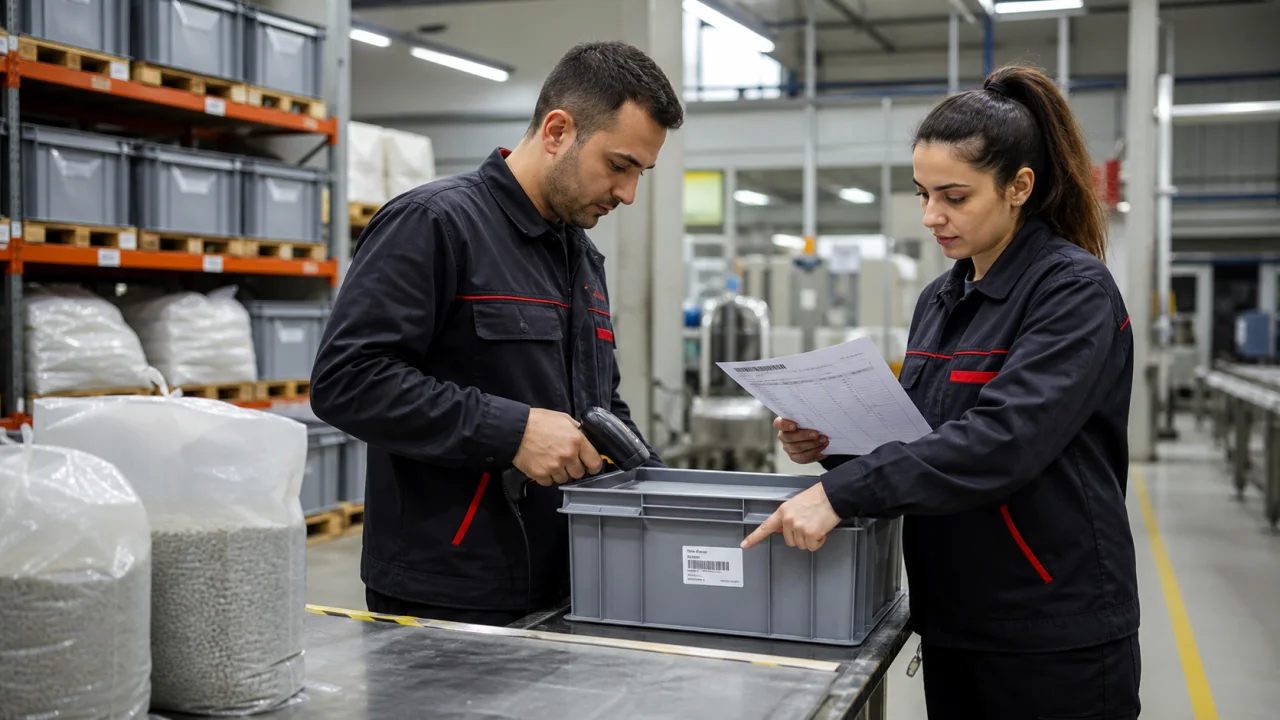
Quality control is not just the final product sorting when production is completed. Controls placed at the right points from raw material acceptance to shipment prevent faulty material from entering production, adjustment errors from spreading to the entire series, and the wrong product from being delivered to the customer. Control criteria vary depending on the product of each business; However, the time of the control, the responsible person, the record and the decision to be made in case of non-compliance must be clear.
Quality Control Is Done Where It Prevents Error From Passing To The Next Stage
It becomes preventive
Input and initial part checks return production to the correct condition before the error grows.
Maintains flow
Intermediate controls prevent non-conforming semi-finished products from proceeding to the assembly, packaging or shipping stage.
produces evidence
Recorded results show which product was accepted, when, by what criteria and by whom.
Final Check May Catch Error Going to Customer; Root Losses Alone Cannot Prevent
For example, if the raw material coming in the wrong lot is not sorted at the first entrance, the defect found at the end of cutting, processing, assembly and packaging will create much higher rework and wastage. Therefore, the checkpoint should be placed in front of the operation where the risk is first visible. The final control does not replace the previous doors; It is the final verification of the product to be delivered to the customer.
6 Quality Control Points to Be Established in Production
The doors below are not a standard that will be applied equally to all businesses. It should be tailored to product risk, legal liability, customer requirement, production method and cost impact. However, the scope of control and decision flow must be written at each door.
Goods acceptance and entry quality
Before the raw material or purchased part is accepted into the warehouse
Wrong material, wrong lot, missing document or non-specification input entering production
Critical criteria by material code, quantity, lot or series, physical damage, certification and technical specification.
Warehouse manager and quality officer; Relevant production or engineering authority if technical acceptance is required.
Goods receipt document, control form, photo or test result, lot record and acceptance decision.
Nonconforming material is separated from usable stock; It is placed in a quarantine location, and the notification to the supplier or the return decision is recorded.
First part approval
After new production order, mold or tool change, setting change and long downtime
Incorrect setting causes the same error to occur on many products
Size, appearance, function, bill of materials, machine setting and, if necessary, sample of the first produced part.
The operator produces; The authorized quality controller or defined production manager gives approval.
Initial part form, measurement result, setting value, approver, date and production order link.
If there is no approval, mass production cannot begin. The setting is corrected, a new sample is prepared and checked again.
In-process control
While production is ongoing, at the frequency defined by product, duration, or batch
Delayed detection of wear, temperature, material change or deviation in operation
Test result according to critical size, visual defect, machine parameter, sound product rate, wastage and sampling plan.
The operator performs his own control; The quality team conducts planned sampling and independent verification.
Operation control form, measurement device result, time or batch information, non‑conformance code and production order record.
When a deviation is observed, the affected amount is determined from the last accepted control point; The decision to stop production, adjust or sort is made.
Inter-operational control
Before the part is handed over to the next operation, subcontracting process or assembly
Hiding the defect in the previous stage with the next process or increasing the rework cost
Acceptance status of the previous operation, quantity, semi-finished product tag, lot or serial connection and transfer condition.
The person responsible for the transferring operation and the person responsible for the receiving operation; quality controller when necessary.
Operation completion record, semi-finished product transfer document, quality result and rejection or repair distinction.
Unaccepted semi-finished products are not sent to the next operation. Decisions on repair, reprocessing, scrap or conditional use are subject to authorized approval.
Final product and packaging control
Before the production order is closed and the finished product is taken into stock
Incomplete assembly, wrong variant, visible defect or faulty packaging masquerading as a good product in stock
Product function, appearance, size, quantity, variant, package content, label and customer or product specification.
Quality control team; Packaging and finished goods warehouse managers complete their own delivery checks.
Final control result, accepted quantity, rejection or repair quantity, packaging control and product receipt record.
The accepted quantity is taken into finished goods stock. Rejection and repair quantities are kept in separate stock status; The production order is not closed before the actual result becomes clear.
Pre-shipment verification
Just before the product is loaded to the customer, dealer or distribution point
Sending the correctly produced product to the wrong customer, with incomplete quantities or with the wrong documents and labels
Order number, product and variant, quantity, case or pallet, lot or series, shipping address, label and document match.
Shipping and warehouse manager; if the customer or sector requires, the quality unit participates in the final verification.
Picking and loading list, delivery note, serial or lot matching, package control and delivery record.
If the mismatched product is removed from the loading area, shipment will not be completed without a second verification after the document or product is corrected.
6 Questions That Must Be Answered in the Control Plan
What to check?
Critical measurement, appearance, function, quantity, label, document or security requirement must be written clearly.
When and how often?
It should be determined whether it will be done at each acceptance, each shift, during team change, or in a certain quantity.
Who will do it?
The role of operator, quality controller, warehouse, production manager or customer approval should not be confused.
According to which tool and metric?
Technical drawings, samples, tolerances, inspection instructions, measuring devices, or sampling plans must be accessible.
Where will the result be saved?
The production order must be associated with the same product via the quality form, lot record or digital control record.
What happens in case of non-compliance?
The owner of the decision to stop, separate, sort, repair, return, conditional acceptance and re-control must be clear.
The decision for non-conforming product should be made before the product moves to the next stage.
A “checked” record alone is not sufficient. Whether the result is acceptance, conditional acceptance, separation or reprocessing; must be visible along with the amount affected and the decision authority.
acceptance
If the criteria are met, the product or material moves to the next defined step. The acceptance decision must be traceable to the product, batch or control result.
Conditional acceptance
In cases where technical evaluation is required for use or for the customer, the decision is made only by the authorized person, writing down the conditions under which it will be used.
Sort and examine
Non-conforming product is kept in a physical or system status that will not be mixed with good inventory or semi-finished goods. The reason, quantity, and next decision are recorded.
Repair or rework
The operation to be performed on the applicable product, responsible and re‑check point are determined. After the operation, the first acceptance result is not automatically considered valid.
How to Proceed When a Measurement Deviation Is Observed?
Split the deviation
Suspicious product is placed in a physical or systemic status to prevent contamination.
Find the amount affected
The production, lot, shift and scope of operation after the last accepted control are determined.
Make the decision
The authority and basis for the decision to adjust, sort, repair, rework or reject are recorded.
Re-verify
The flow is not considered normal until the first piece or affected product is re-checked after correction.
If the nonconformity is recurring, it is not enough to separate the faulty product alone. To investigate with evidence why the error is repeated 5 Whys analysis guide you can use Also to link the control result to the correct product, batch or series batch and lot tracking It is important.
How to separate the product in the warehouse when an error is found, which operations will be blocked in stock and how to open it for re-shipment. In the inappropriate product tracking guide and review it.
Quality Checklist: Before You Start in the Field
Just looking for errors in the last check
By the time the defect is found in the final product, the cost of materials, labor, time and subsequent operations may have already been incurred.
Applying the same intensity of control to each product
When critical risks and low-risk features are not separated, the team cannot devote enough time to the most important control.
Using verbal confirmation instead of control result
If there is no batch, shift, date and responsible record, it cannot be verified later which quantity was accepted.
Keep the non‑conforming product together with the good inventory
If there is no physical or system distinction, a return, repair or pending product may inadvertently move to the next stage
Weeding out the same inconvenience alone
Extraction can reduce error to the customer; However, if the source is not investigated, the same loss will repeat in every batch.
Leaving the controller and criterion unclear
If the same measure is evaluated with a different tool, method or interpretation, the control result will not be reliable.
Control Result Should Not Be Separate From Production Record
Control result; When kept together with product, production order, operation, lot or series, shift, measurement result and decision, production and quality teams talk about the same event. Thus, instead of searching for information in different files for pre-shipment verification, return review and repetitive error analysis, the relevant record can be accessed.
For products requiring serial-based tracking Difference between serial number tracking and lot tracking Setting it correctly clarifies which physical product the quality decision affects.
Frequently Asked Questions
Does the operator or the quality unit perform quality control?
The two can undertake different tasks. The operator must control his own work against defined criteria; Independent quality control strengthens verification and acceptance decisions on critical features. Distribution of authority must be written according to product risk.
Is 100% control mandatory for every product?
Not always. One hundred percent control or sampling plan can be selected based on product risk, customer requirement, process stability and error cost. The basis for the sampling decision at critical features should also be defined.
When is the first part approval repeated?
In addition to starting a new production, it can also be repeated in situations that may affect the result, such as changing molds, tools, settings, materials, programs or operators. The business should clearly state these triggers in its control plan.
Does production always stop when a non‑conforming product is found?
The type of nonconformity, the amount it impacts, and security or customer risk determine the decision. At the very least, the suspect product should be separated, the area of influence should be determined, and the safety of subsequent production should be evaluated by the competent person.
To evaluate the connection of control points to the production order Scope of production tracking program examine; Verify acceptance, hold and release rules for your business.
Manage checkpoints with production order, stock and shipping records
How work order, material, operation and result records are linked together in the production process in the production order guide and examine it.