
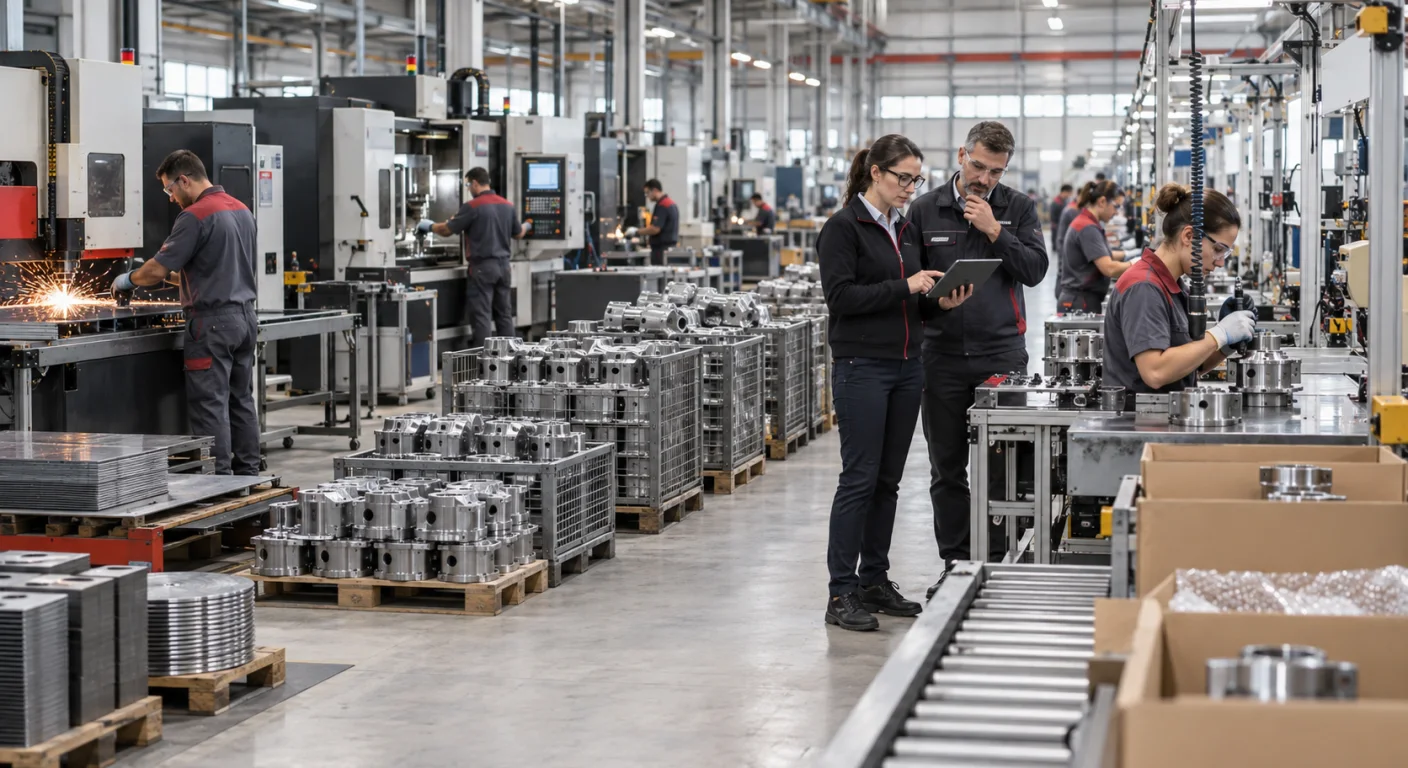
A bottleneck in manufacturing is a machine, operation, personnel, material, or decision point that limits the total output of a line or production system. A bottleneck often manifests itself with semi-finished products piling up in front of it, stations waiting for work behind it, and recurring deadline delays. But looking at the slowest machine alone is not enough to find the right spot.
Why Does Bottleneck Slow Down the Entire Production Line?
Semi-finished product and the tail grows
Previous operations appear fast; However, the parts they produce remain in stock before they can proceed to the next stage.
Stations wait for work
Even if the subsequent operations have capacity, the total output of the line does not increase because there is not enough product.
Therefore, what is important is not the high utilization rate of individual machines, but how regularly the product moves along the entire flow. Uncontrolled production in front of the bottleneck can increase the semi-finished product and delivery time without increasing the total output.
What are the symptoms of a bottleneck in production?
Semi‑finished goods accumulate at the same point
Parts wait in front of a particular machine or work center while the previous operation continues producing.
Queue time exceeds processing time
The product waits in line for hours or days for a few minutes of processing.
Deadlines are delayed in the same operation
The delay in different products and orders constantly becomes visible after the same work center.
The source constantly operates at high load
Certain machines, molds, teams or personnel are constantly occupied while other stations have vacancies.
Next operation waits for material
The station after the bottleneck sometimes remains idle or operates irregularly because it cannot be fed.
Urgent work order changes constantly
The plan is disrupted to melt the queue; priority changes increase preparation loss and waiting even more
Why Is The Order Delayed Again When The Cutting Is Fast?
The values below are an example daily production scenario prepared to demonstrate the method. The daily demand of the line is 100 pieces. Although cutting and machining produces more products, the output of the line is limited to assembly, as assembly can only complete 80 parts.
cut
It feeds the next process faster than necessary.
Processing
It increases the savings before assembly.
assembly
Bottleneck that limits the throughput of the line.
Packaging
Waiting for product from assembly.
How to Detect a Bottleneck?
Observe
Watch the actual flow of work in the field. See where queues are forming, which station is waiting for supplies, and where priorities have changed.
measure
Record input, solid output, cycle time, waiting, downtime, queue quantity and current capacity load per operation for the same period.
verify
Do not consider a single-day failure or delayed material as a permanent bottleneck. Check whether the same constraint repeats in different shifts, products and orders.
heal
First reduce the loss time of the current resource; advance preparation, verify quality upon entry, balance work, and give controlled work to the bottleneck.
measure again
Compare queue, daily throughput and delivery time again. Take into account that after remediation the bottleneck may be moved to another operation.
Not every queue is a permanent bottleneck
A malfunction, delayed material, quality block or urgent order may create a short-term backlog. A permanent bottleneck is a point that constantly limits the system's output, recurring under normal operating conditions and in different orders. For this reason, investment decisions should not be made based on a photo of a single shift.
Is the Bottleneck Caused by Machinery Only?
machinery or equipment
Insufficient capacity, long adjustment, frequent micro stops, special mold or process that can only be done on one machine.
Workforce and competence
Work that can only be done by certain personnel, unbalanced task distribution, lack of shifts or lack of standard work.
Material and quality
Missing material, late quality approval, inappropriate parts, rework or sending faulty product to a bottleneck.
planning rule
Too much work at the same time, frequent priority changes, large batches, wrong product order or loading above actual capacity.
external process
Flow interruption due to outsourcing, supplier, laboratory, customer approval or shipping window.
How to Reduce the Bottleneck in Production?
The first solution is not always to buy a new machine. First, examine whether you actually allocate the current constraint's time to production, whether erroneous or unplanned work is coming your way, and whether previous operations have expanded the queue uncontrollably.
Save the bottleneck's time
Get materials, drawings, tools, molds and operators ready before the bottleneck becomes empty. Breaks and shift transitions should be planned in a controlled manner.
Don't send the wrong job to the bottleneck
Perform input quality check before throttling. The faulty product processed at the bottleneck consumes not only materials but also limited time that cannot be recovered.
Limit work emissions
Letting previous operations just produce more makes the tail bigger. In fact, release work as fast as the bottleneck can consume it.
Reduce preparation and change loss
Sort similar products in the appropriate order; Prepare the tool, bill of materials and program before the machine stops. Consider separately the inventory impact of the large batch.
Transfer eligible jobs to another source
Evaluate the alternative machine, parallel station, shift support, cross training or controlled subcontracting option along with quality and cost.
Connect investment decisions to data
If the constraint remains after overtime and process improvement, justify additional machinery investment with demand, usage and total flow impact.
Keeping All Machines 100% Charged May Not Improve Flow
Continuously running the stations before the bottleneck may indicate high local efficiency; However, if limited resources cannot consume this work, the semi-finished product, space requirement and follow-up burden increases. The aim is not to keep every resource full at the same time, but to ensure that the customer order passes through the entire line evenly.
What Data Should Be Kept for Bottleneck Analysis?
Queue quantity
Work order, quantity or standard time waiting for the operation.
Queue and waiting time
The time between the moment the job is ready and the moment it begins operation.
Actual cycle time
Actual time based on product and operation from start-finish records.
solid output
The amount that can be transferred to the next operation by hour, shift and day.
Posture and preparation
Lost time due to malfunction, adjustment, material, quality, operator and planning.
Load and deadline effect
The load of open jobs on the resource calendar and their impact on the order delivery date.
These data should be generated not only in the period‑end report but also during work order and operation occurrences. The on‑site record structure of the production order in the production order guide; How is plannable capacity calculated? In the production capacity calculation article you can review. If there is a problem with posture, you can also Reasons for unplanned downtime must be separated.
Frequently Asked Questions
Is the slowest machine always the bottleneck?
No. The machine that seems slow may be keeping up with demand. A bottleneck is the resource in that product flow that actually limits the total throughput and delivery time.
Can the bottleneck change over time?
Yes. Product mix, order load, shift, malfunction, investment or improvement may move the constraint to another operation. Therefore, remeasurement is required.
Will overtime solve the bottleneck?
It can reduce short-term capacity shortage; However, if preparation, quality, material or planning problems persist, it is not a permanent solution and may increase costs.
Does OEE alone indicate a bottleneck?
OEE indicates the availability, performance and quality loss of equipment. In addition to these, the queue, workload, product route and total output of the line should be evaluated together in the bottleneck decision.
Evaluate Flow with Actual Capacity
Lean Enterprise Institute considers constraint as the limiting point that prevents the system from producing more output. Microsoft's finite capacity planning disclosures also indicate that resources can be overloaded and delivery dates unrealistic in plans that do not take existing capacity reservations into account.
The line values in this article are an example scenario prepared to demonstrate the method; Actual investment and shift decisions should be made with the business's verified time, demand, quality and cost data.
To evaluate the bottleneck along with the order sequence and capacity load scope of production planning and scheduling You can review; The efficiency of a single machine does not explain the entire flow.
Monitor production flow with work order, operation and capacity data
Identify bottleneck work centers, pending work and term impact KG Palaimon Evaluate how you can make it visible within the context.