
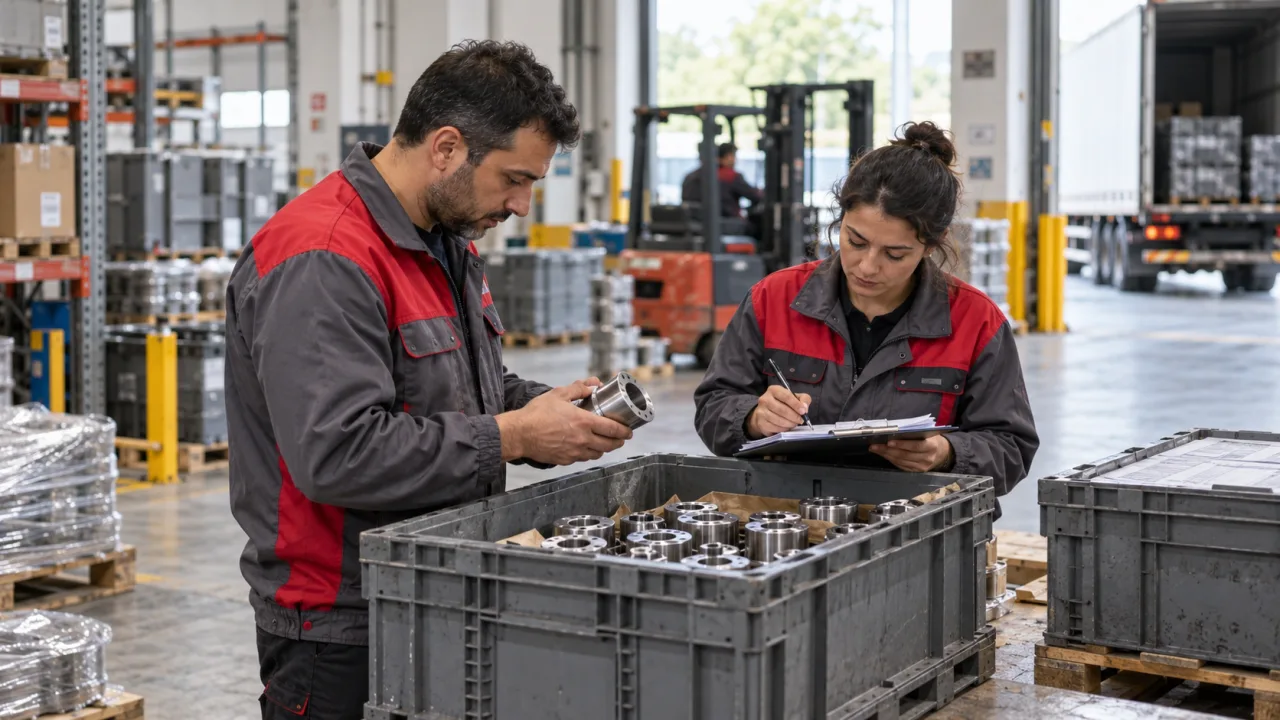
Contract manufacturing tracking includes not only the delivery date of the outsourced work; It is to monitor in the same work order where the material sent is, how much semi-finished product is returned, how much is wasted and how much balance remains with the subcontractor. Accepting the entire quantity shipped in partial deliveries as returned misleads inventory and production planning
Every Shipment and Return Must Be Linked to the Same External Operation
First define the subcontracting work order and the expected output. Send the material with documentation, track the subcontractor's balance separately. Record quantity and quality status at each partial return; clearly separate waste or return. The job should close only when records agree with physical quantities.
What Should Be Defined Before Starting Contract Work?
The external operation should not be just a general “outsourced” note. Which operation of which production order will be carried out outside, who the subcontractor is, the code and batch of the material to be sent, the expected semi-finished product, the unit of measurement and the target return date should be determined. If the output and return are in different units, the conversion rule and expected waste range should be written separately.
Who owns the material and with what document it will be transported should be clarified together with the contract and the accounting practice of the business. The part that physically goes to the subcontractor should not be off track in terms of production. To see in detail how to set up a work order production order guide and examine it.
How to Track Contract Manufacturing?
The following five steps track the material movement and service record of an exported coating or machining operation. The document names and automatic records used may vary depending on the ERP installation; The important thing is to link the steps together.
Open subcontracting work order
Link the production order, external operation, subcontractor, parts to be sent, expected return quantity, unit of measure, deadline, and service fee basis to each other.
Send the material
Save physical output with document and batch information; Continue to monitor the quantity at the subcontractor's stock or external operations location.
Watch the transaction
Update start, wait, planned return and delay information in the work order; Do not consider verbal situation information as a single record.
Accept partial return
Count the incoming semi-finished goods, determine the quality status and pass only the accepted quantity to the next operation or appropriate stock status.
Close balance
Reconcile the accepted quantity, documented waste, return and remaining amount with the subcontractor; Link the service invoice to the relevant external operation.
How to Find the Open Balance When 1,000 Pieces of Materials Are Sent?
For example, let's say 1,000 metal bodies are sent to a subcontractor for plating. One coated semi-finished product is expected from each body; Therefore, the input and output unit is pcs. The subcontractor returns products in two separate batches. The values below are sample records prepared to demonstrate the method.
Metal body that is sent to the subcontractor for coating and is expected to be returned exactly.
Semi-finished product whose counting and quality control has been completed.
Semi-finished goods accepted with separate return document.
Processing loss whose cause and responsible is examined and recorded in the work order.
The amount that has not yet been closed due to delivery, wastage or return.
1,000 sent = 600 + 350 accepted + 20 documented waste + 30 open balance
950 semi-finished products were accepted. There are records of 20 wastage decisions. The remaining 30 pieces are not automatically counted as waste or delivery; It is tracked as open quantity at the subcontractor and tracked according to the deadline.
This equality is only meaningful when the quantities are kept in the same unit and within the same work order. In jobs where the material sent by weight is returned in quantity, bill of materials, conversion and process loss should be modeled separately. If batch or lot information is important, a traceability chain should be established between the shipped material and the returned semi-finished product; details of this in the party and lot tracking guide is found.
Which Record Should Be Left for Partial Delivery and Quality Acceptance?
“It came from the subcontractor” is not the same as “available for production”. The received quantity is first counted and matched with the work order. Products awaiting inspection are kept separate; the suitable quantity is accepted, and for the unsuitable quantity a return, rework or scrap decision is made. Thus the next operation is not planned based on semi‑finished goods that are actually not usable.
physical return
Actual quantity and document date received from the subcontractor.
quality awaiting
The amount that has been counted but has not yet been released to the next operation.
Accepted
The quantity whose control is completed and recorded as a suitable semi-finished product.
When are Subcontracting Service Expenses and Work Orders Closed?
The purchasing or invoice record of the subcontracting service must be linked to the relevant external operation. Pricing of the service based on quantity, weight, duration or batch varies depending on the contract. For this reason, cost should not be charged to the production order without comparing the invoiced amount, the accepted work and the rework or waste agreement, if any. The method affects the product cost; However, the purpose here is not to calculate the general cost, but to avoid losing track of which service belongs to which job.
In the example, it would be misleading to mark the work order as “completed” when there are 30 open balances. The remaining amount is received, refunded or transferred to another situation with a documented decision. Then, the stock, semi-finished product acceptance, wastage and service record at the subcontractor are checked together and the operation is closed.
Check Before Closing the Subcontractor Balance
Work order link
Does the shipment, return and service record show the external operation with the same production order?
Quantity and unit
Are unit, kilogram or meter conversions clear? Are partial deliveries recorded separately?
stock status
Is the material at the subcontractor mixed with the return awaiting quality and the accepted semi-finished product?
Waste decision
Is the reason for the lost quantity documented with approval and, if necessary, a return or compensation decision?
Term and service
Have the delivery date of the open quantity and the amount of services to be invoiced been reconciled?
For another scenario where contract manufacturing and color-number variants are managed together contract manufacturing and variant writing you can look. This guide focuses specifically on the amount and document reconciliation of the foreign operation.
Frequently Asked Questions
Does material sent to the subcontractor get fully deducted from inventory?
Physically leaves the business warehouse; However, in order to track the work, the amount at the subcontractor must be monitored in a separate location or status. Accounting and property registration are evaluated according to the contract and the system used.
Can the entire semi-finished product be used?
No. Quantities that are physically received, pending quality control and accepted must be kept separate. Only the quantity that passes quality is transferred to the next operation.
What is the difference between waste and open balance?
Waste is a loss whose cause and decision are recorded. Open balance is the amount that has not yet been closed due to delivery, return or wastage; cannot be assumed to be lost.
Can there be more than one subcontractor in a work order?
Maybe. Subcontractor, shipping, partial return and service records of each external operation should be kept separately; All operations must be linked to the parent production order.
Establish Document and Quantity Chain Together
Microsoft's subcontract order and external operation examples of associating documents, production order, material transfer, service receipt and return record. This article is not a product feature list or a legal opinion regarding the document system in Türkiye; The document and accounting practice should be verified with the business' advisors.
To control material issue, return and open balance chain in the contract manufacturing tracking guide You can also examine the registration approach.
Do not separate the open quantity from the subcontractor from the work order
For production order, inventory movement and external operation record KG Palaimon production ERP scope examine; Compare it to the requirements of your own subcontracting process.